





Sinister Wisdom Newsletter
Login (ONLY for SW staff)


The Dyke & the Dybbuk by Ellen Galford
A tongue-in-cheek Jewish folklore featuring corporate demons, a yearning lesbian, and something like a romance . . .
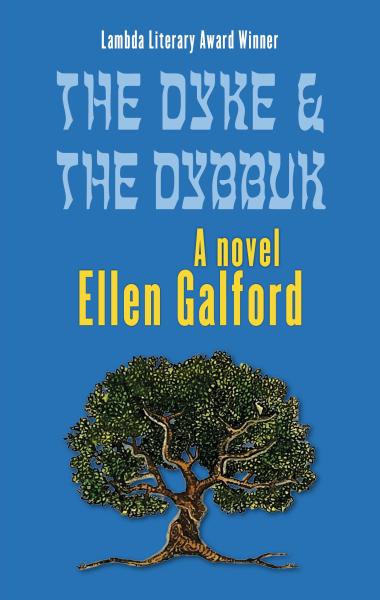
Meet Rainbow Rosenbloom: a Jewish lesbian taxi driver and film reviewer in London. Her life is upended when she is unexpectedly possessed by the dybbuk Kokos, a mischievous Jewish demon. After 200 years of exile, Kokos returns to a world utterly transformed and ready to make trouble as a dybbuk must.
Confronted with late-stage capitalism, corporate culture, and computers, Kokos struggles to haunt with her old-world flair. As Kokos and Rainbow navigate this unfamiliar landscape together, an unlikely partnership forms: Kokos learns to survive in the modern age, and Rainbow comes to value her sarcastic, supernatural sidekick.
Originally published in 1993, The Dyke & the Dybbuk remains strikingly relevant. Witty, satirical, and full of heart, The Dyke & the Dybbuk is a sharp comedy about religion, family, queer identity, and the absurdities of modern life. The Dyke & the Dybbuk will leave you laughing and thinking.
Praise for The Dyke & the Dybbuk:
“Deliciously literate and constantly surprising, Ellen Galford's shuffles traditional Jewish mysticism with 20th-century technology. The result rings like klezmer music: joyous, mournful, funny, and above all, heymish....the book is swift, smart, accessible, and enormously likable--a welcome addition to lesbian and Jewish literature.”
— Harvard Gay & Lesbian Review
“A fun, feisty, feminist romp through Jewish folklore as an ancient spirit returns to haunt a modern-day London lesbian. Craft, camp, and chutzpah.”
— Kirkus Reviews
“Ellen Galford weaves an intricate web of vengeance, family politics, Jewish customs, film critiques, culinary styles and, of course, true love. This is a highly amusing, cleverly scripted novel. Galford once more manages to poke fun at religion without being insulting or offensive—though the same probably can’t be said for blasphemous. I thoroughly recommend this book: go out and get it.”
— Jennifer Marchbank, Gay Scotland
“In pre-modern England, a Jewish lesbian invokes a curse on her unfaithful lover Gittel's marriage to a man. Jewish feminist writer Ellen Galford's funny, perceptive and irreverent novel skewers Jewish orthodoxy, completely re-imagining the folk myth of spiritual displacement by a male dybbuk of his dissociated female host. Ready for an exorcism, anyone?”
— Yiddish Schmoozers in Translation
“In this very Jewish novel, a medieval lesbian puts a curse on her ex-lover by conjuring up a dybbuk to haunt her and her firstborn daughters unto the 33rd generation. But Kokos, the dybbuk, gets exorcised and incarcerated in a tree for 200 years. Upon her release, she must make good on her contract. Tracking down London cab driver and lesbian film critic Rainbow Rosenbloom (ninth generation of firstborn daughters), Kokos wreaks havoc—much of it feminist and in-your-face. Culturally sensitive to dybbuks (which is not surprising, given that the narrator is one), this book is beyond.”
— Karen Bekker, Lilith Magazine
Ellen Galford is a writer, book editor, poet, and recipient of the 1994 Lambda Literary Award in Humor. She is the author of Moll Cutpurse: Her True History (1984), Queendom Come (1990), and The Fires of Bride (1986), which was later reproduced as a piece of alternative musical theatre by Red Rag—a radical women's theatre company—and toured the UK in the early 1990s. In addition to her lesbian novels, Ellen has also published poetry in both English and Yiddish, short fiction, essays, and nonfiction appearing in The Slow Mirror and Other Stories: New Fiction by Jewish Writers, Rainbow City: Stories from Lesbian, Gay, Bisexual and Transgender Edinburgh, The Essential Guide to Genealogy: The Professional Way to Unlock Your Ancestral History, Shofar, and many more. Much of Ellen's work explores themes of the historical and supernatural, including her collaboration with composer Phil Alexander on performance pieces centering Jewish and Scottish history. She lives in Edinburgh.
Press Kit for The Dyke & the Dybbuk.
Celebrating the Launch of Dyke & the Dybbuk Event Recording & Assets
Image:

"Empowerment comes from ideas."
― Charlene Carruthers
"Your silence will not protect you."
— Tourmaline
"Gender is the poetry each of us makes out of the language we are taught."
— Leila Raven