






Sinister Wisdom Newsletter
Login (ONLY for SW staff)


Review of Trans Femme Futures: An Abolitionist Ethic for Transfeminist Worlds by Nat Raha and Mijke van der Drift
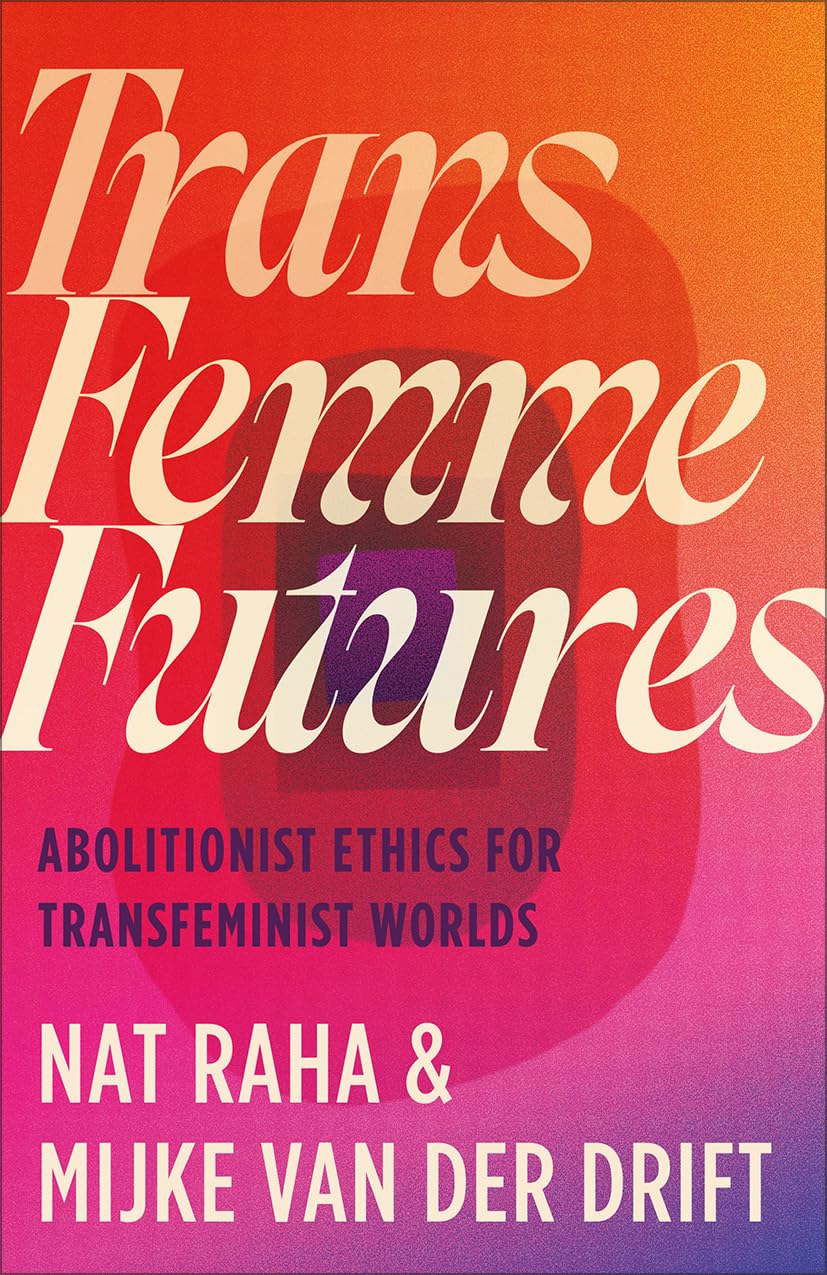
Trans Femme Futures: An Abolitionist Ethic for Transfeminist Worlds
Nat Raha and Mijke van der Drift
Pluto Press, 2024, 256 pages
$22.95
Reviewed by Allison Quinlan
I received a free copy of Trans Femme Futures in late 2024, shortly after For Women Scotland, funded in large part by famed TERF (trans-exclusionary radical feminist) Joanne K. Rowling, defeated the Scottish Government in the High Court, forcing them to define ‘woman’ based solely on ‘biology.’ Trans individuals were not consulted, did not testify, and were not considered when the European Court of Human Rights (ECHR) issued guidance to practitioners following the decision. Effectively, rights were stripped from trans, nonbinary, intersex, and non-‘normative’ women across the country, including rights to support services following abuse, as well as the ECHR issuing toilet bans. Trans men were seemingly not targeted in the guidance, only trans women. So, Pluto Press offered Trans Femme Futures to help us understand how transfemme individuals are perceived socially and invited us to imagine a world where existence is not criminalised, erased, or constantly threatened.
From the start, Trans Femme Futures outlines the importance of rejecting ideas giving legitimacy solely to individuals who fit social ideas of transness—in their words, “a body that is legibly and visibly trans, in public or in private.” As they note throughout the work, multiple factors influence individuals’ presentations and how they are perceived based on race, ability and health, access to healthcare, size, and more. Breaking out of these assigned femme ideals is as much a method of active disruption as it is of creating an existence that is one’s own, rejecting conformity to yet another gendered expectation. Following the thread of self-expression outside assigned ideals, the work discusses assimilation and respectability politics regarding sexuality:
Like queer liberalism before it, the sanitised reframing of trans and non-binary folks might make some of us more respectable, but often at the expense of those of us who wear our sexualities upon our sleeves, or those of us who are objectified and hyper-sexualised (most often Black and Brown trans women and other trans people of colour).
After establishing the dynamics of heteronormative and cisnormative social interactions in conversation with transfemme lives, bodies, and spaces, the work moves on to the theme of community, which is present throughout the rest of the work. The authors explore the differences between a community (group members have something in common but don’t necessarily know everyone) and a collective (existence through direct relations), and how these can contribute to organising for a better future. However, they warn against experience-led organising creating an obligation to participate, and emphasise the importance of holding differences within organising spaces, noting that care should be mutual.
Across the chapters, the authors argue that trans liberation won’t be granted by the structures that currently oppress us, and they take an abolitionist, grassroots approach to building a future. Community and collective struggle stay at the core of their roadmap for trans femme futures:
Part of the work of overcoming oppressions, including internalised oppressions, entails countering the voices and affective economies that claim we are not worthy of support, while building the social infrastructures and worlds that can open the space to articulate one’s needs—in a way that is couched in consent.
Solidarity, which aims for total liberation, is the path forward. In a time when courts write trans erasure into policy, Trans Femme Futures insists we’re already forming a better future collectively. The work comes to a close, centering joy: “In the end, it’s all about the joy of living our lives and the pleasure of shaping them together.”
Allison Quinlan is a PhD student in Scotland and quite angry at people who continue to buy Harry Potter. At least learn to pirate!
"Empowerment comes from ideas."
― Charlene Carruthers
"Your silence will not protect you."
— Tourmaline
"Gender is the poetry each of us makes out of the language we are taught."
— Leila Raven