






Sinister Wisdom Newsletter
Login (ONLY for SW staff)


Review of Dancing Backwards Towards Pluperfect by Koss
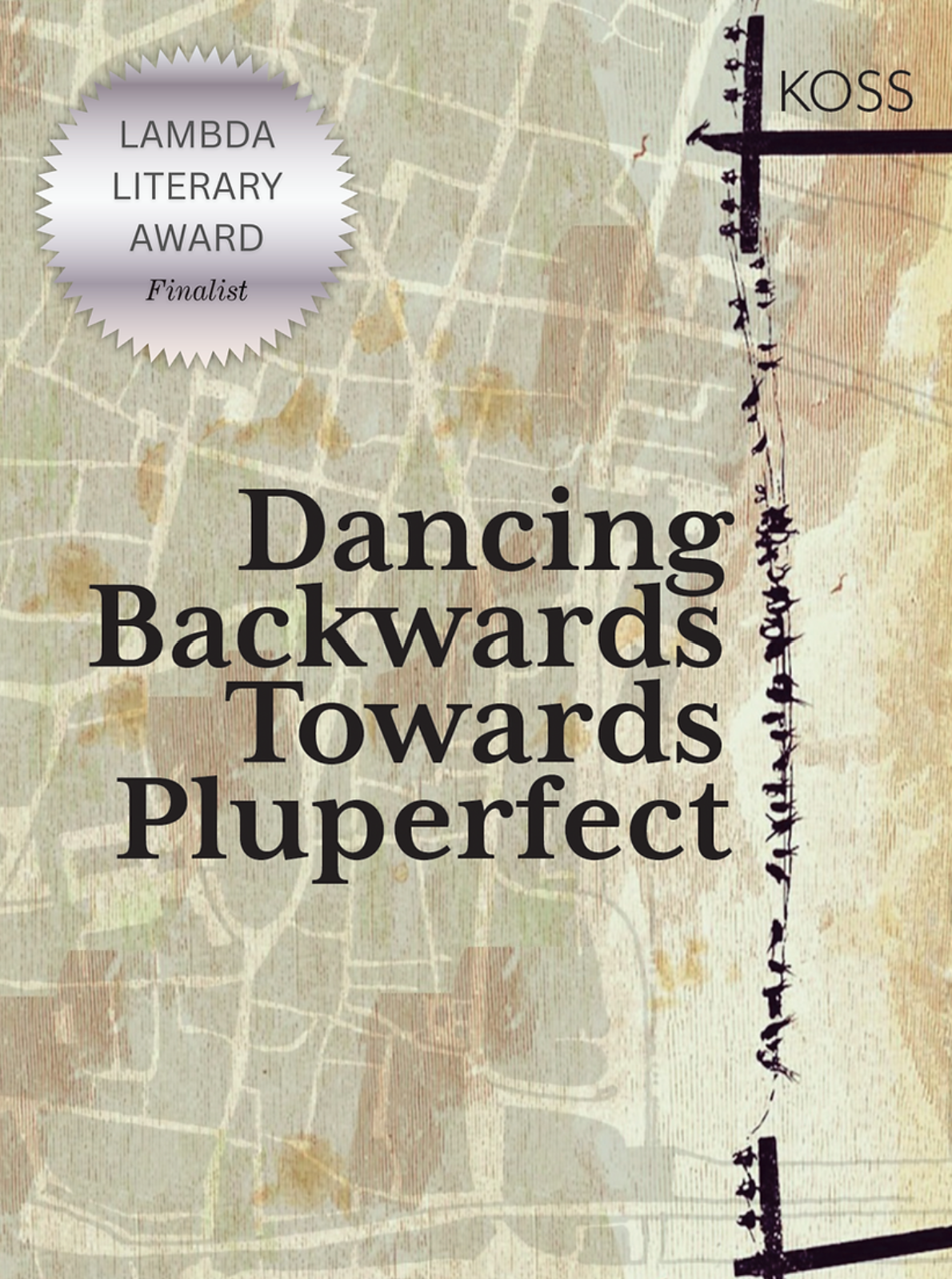
Dancing Backwards Towards Pluperfect
Koss
Diode Editions, 2024, 52 pages
$12.00
Reviewed by Jenny Wong
Dancing Backwards Towards Pluperfect by Koss is a Lambda Literary Award Finalist that takes the gritty scuffs and shapes of life and condenses them into twenty-eight poems which challenge the reader to observe what happens in the aftermath, the retrospect, and beyond.
The poem “A Modern Highway of Death,” although it may not have intentionally been written to describe the collection, sums it up well: “The world, you see/and don’t, is in flux between / Connections and short circuits.”
Words sparkle and spark with color, painting surreal scenes that bring to life human moments through a queer lens. Although the chapbook’s title feels playful, the weight of grief, suicide, abuse, and other traumas weave its way throughout. Titles such as “Things to Do When an Abuser Dies” and “Flint Girl Handcuffed Along Dort Highway” forewarn of troubles to come. However, despite the darkness that unfolds within the boundaries of a page, Koss’ skill as a writer shines in what they choose to reveal and what is left obscured in the shadows. The language in this collection is both visual and visceral, blending the starkness of reality with a soft filter of the surreal. The collection never shies away from the truth of the experience, nor from the impacts of events that ripple and rebound into the current day.
There are several stunning list poems in the collection which is a form Koss adeptly uses to convey events, possibilities, and introspections. Listed items dialogue with each other, find humor in the aside, and use brevity to condense observation into its most potent form. One such example is the list poem “Ten Things to Remember ‘Bout Me When I’m Dead.” The first entry starts out swinging: “1. I was a victim more than once, but said no and no and no; I’m / the craggy boxing bitch, staggering through the bloodstream. / Dig my damn red lace-up boots, I wore them just for you.”
Peeking through the heaviness, Koss still manages to show a world of color and humor. Visuals dazzle and word choice challenges the reader to see something new in a scene that may or not be familiar. “A Dyke Cowgirl Takes Herself on a COVID Taco Bell Date,” sets the stage for a drive-thru encounter that Koss makes anything but mundane: “Hand a five to a large hairy man in glittery bunny ears fixed / to a plastic tiara, singing into his mask, hump dancing and / in-the-moment-happy. They work sixty hours with overtime / that inches them just out of the poverty bracket if you / discount health insurance.”
Throughout the collection, there are several poems with the word “Zuihitsu” appended between parentheses in their titles. Zuihitsu, which means “follow the brush,” is a genre in Japanese literature that focuses on the responses elicited by an environment. Koss shows us that although people and places can shape us, they do not define us. A person can choose to create their own colors and perceptions in order to transform past events into stories of survival, recovery, and an exploration of life itself.
Jenny Wong is a writer, traveler, and occasional business analyst. She is the author of Shiftings & Other Coordinates of Disorder (Pinhole Poetry, 2024) and resides in Canada near the Rocky Mountains where she makes short poetry films and plans her next adventures. Find her on X, bluesky, and instagram @jenwithwords.
"Empowerment comes from ideas."
― Charlene Carruthers
"Your silence will not protect you."
— Tourmaline
"Gender is the poetry each of us makes out of the language we are taught."
— Leila Raven