






Sinister Wisdom Newsletter
Login (ONLY for SW staff)


Dyke Bar* History: 1920s-1930s Reading Guide
Dyke Bar* History: 1920s-1930s
Jack Jen Gieseking with Michaela Hayes, Mel Whitesell, Paige LeMay, Syd Guntharp, and Sarah Parsons
To complement the launch of the Our Dyke Histories podcast, hosted by Jack Gieseking and co-produced in collaboration with Sinister Wisdom, we’re sharing a reading guide for the decades. For the first season, Our Dyke Histories is spotlighting dyke bars*: lesbian bars, queer parties, and trans hangouts; the structures that made them necessary, the lives they made possible, and the worlds we built from them.
- The LezQueer World before Bars: 1920s-1930s with Lillian Faderman & Cookie Woolner (Part 1)
- When Paris and Berlin Were Dyke Bars* of the 1920s-1930s with Lillian Faderman & Cookie Woolner (Part 2)
- Tea, Anarchy, and the First Dyke Bar: Eve’s Hangout 1925 with Jonathan Ned Katz (Part 1 of 2 with Katz)
- Books, Bulldaggers, and the Birth of Lesbian Research with Jonathan Ned Katz & Julie Enszer (Part 2 of 2 with Katz)
- The LezQueer World before Bars: 1920s-1930s with Lillian Faderman & Cookie Woolner (Part 1)
- When Paris and Berlin Were Dyke Bars* of the 1920s-1930s with Lillian Faderman & Cookie Woolner (Part 2)
- Tea, Anarchy, and the First Dyke Bar: Eve’s Hangout 1925 with Jonathan Ned Katz (Part 1 of 2 with Katz)
- Books, Bulldaggers, and the Birth of Lesbian Research with Jonathan Ned Katz & Julie Enszer (Part 2 of 2 with Katz)
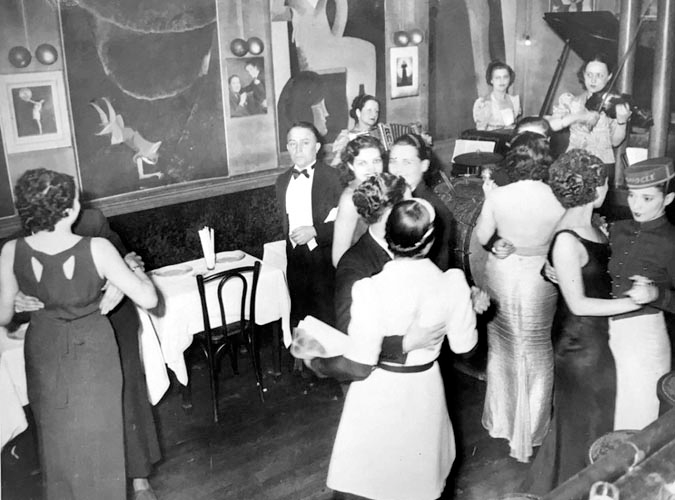
When we talk about the 1920s and 1930s as a queer era, it’s usually framed in smokey Harlem cabarets, Greenwich Village speakeasies, and stolen glances around the world. Prohibition blurred the lines between respectable and illicit nightlife, creating underground spaces where coded glances, whispered introductions, and backroom gatherings could bloom into something bigger. Even as laws and morals tried to shut queerness, gayness, lesbianism, and transness down, urban centers were buzzing with creativity and connection. Lesbian, gay, and LGBTQ bars, cafés, and parties emerged as places to test out desire, find chosen family, and build lives beyond the reach of traditional expectations.
Our foremothers and fore-gender-expansive ancestors weren’t just surviving: they were innovating nightlife, creating dyke bars before “dyke bar” was even a recognized category, and leaving us receipts that are still hot a century later. These decades did not offer safety, but they did offer possibility. People built bars, cafés, salons, parties, and networks. These were spaces where lesbian life was not merely surviving, but generating new social forms. What constellated in these rooms—intimacy, style, mutual support, conflict, eroticism, art—was at once ordinary and transformative. The spatial politics of these sites reveal much about how lesbians negotiated risk, surveillance, class, race, and gender presentation to create something like a livable world.
The interwar period is often treated as an interlude, but they were foundational to our present day's lesbianism and lesbian spaces. These dyke geographies still structure how we inhabit nightlife, how we seek community in the day and night, and how we create lesbian belonging. From Greenwich Village to Montparnasse to Harlem’s rent-party circuits; dykes, bulldaggers, lady lovers, and gender-expansive people were inventing infrastructures of connection. A century later, the monocles and tea rooms might be artifacts—racecar-driving lesbians are still happening, of course—but the geographies they built echo in every lesbian bar, queer house party, and trans do-it-yourself gathering where we continue to make space for ourselves and one another.
While many of you already know the long-adored Odd Girls and Twilight Lovers: A History of Lesbian Life in the Twentieth Century by Lillian Faderman–a revered and trusted source of lesbian history–we’ll be reviewing two new amazing books and some venerable images of 1920s-1930s dyke bar* history on the podcast. Stay tuned!
Read the rest of the series:
Eve’s Hangout, Greenwich Village, 1926
Le Monocle, Paris, 1932
Harlem Rent Parties of the 1920s and 1930s
"Empowerment comes from ideas."
― Charlene Carruthers
"Your silence will not protect you."
— Tourmaline
"Gender is the poetry each of us makes out of the language we are taught."
— Leila Raven
Comments
SYG (not verified)
Tue, 12/30/2025 - 12:04
Permalink
This is so fabulous! Can't
This is so fabulous! Can't wait to listen!
Add new comment