





Sinister Wisdom Newsletter
Login (ONLY for SW staff)


Review of The Night Alphabet by Joelle Taylor
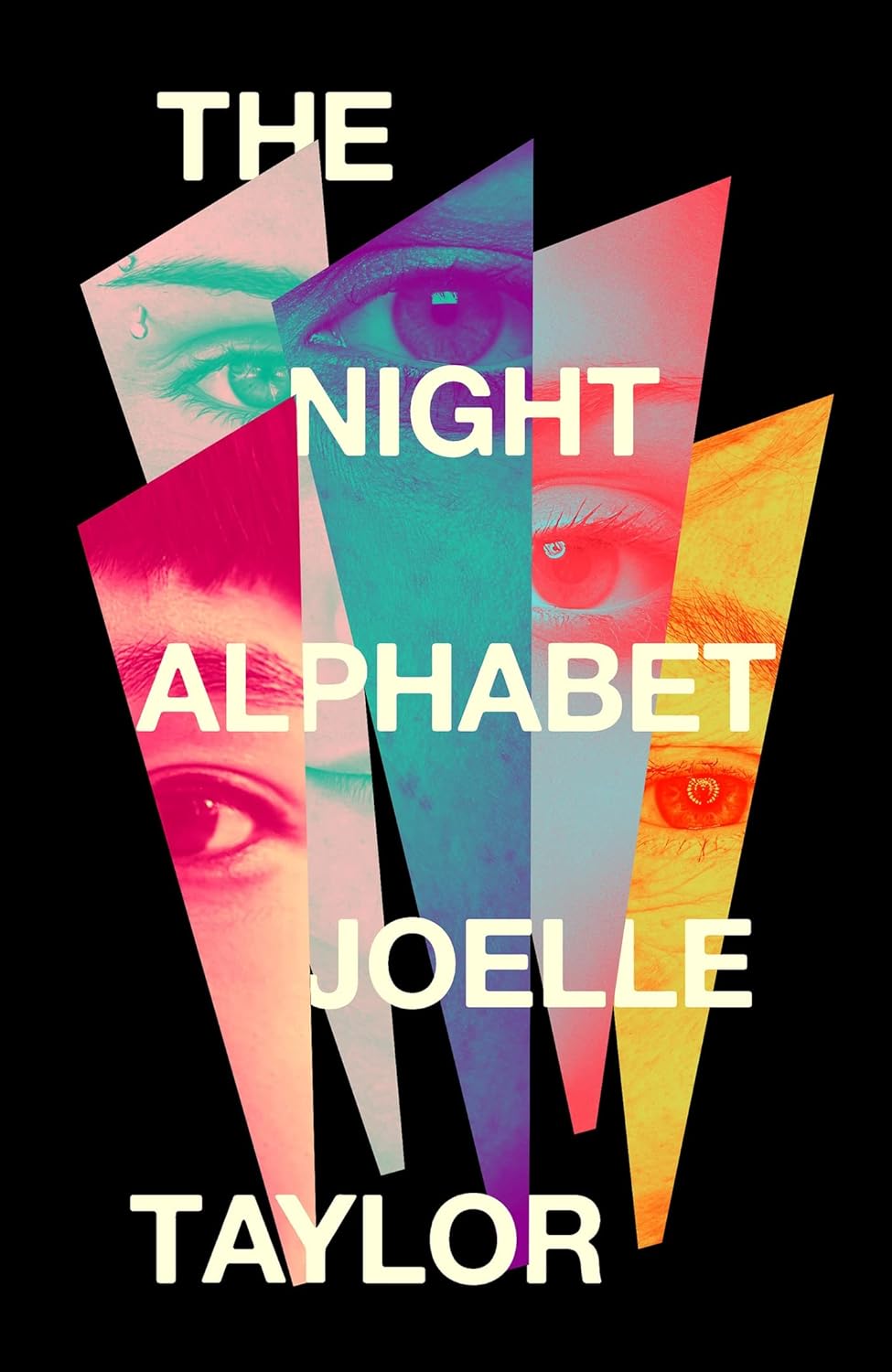
The Night Alphabet
Joelle Taylor
riverrun, 2024, 432 pages
$18.99
Reviewed by Courtney Heidorn
Within the last couple of years, it feels like all of my favorite poets are releasing their debut novels—Kaveh Akbar with Martyr!, Ocean Vuong with The Emperor of Gladness, and Joelle Taylor with The Night Alphabet. Like Akbar and Vuong, Taylor’s debut is nothing if not poetic and experimental.
The Night Alphabet follows a young girl, Jones, who learns that she can embody other people’s lives across time—a coal miner, an incel, a eugenist—and then finds out that her mother and grandmother can do the same. This embodied time travel (or “rememberings,” as she calls it) comes to a head when Jones walks into a tattoo parlor in Hackney, London, in the year 2233. Covered head-to-toe in tattoos that commemorate her journeys, she asks the tattoo artists, Small and Cass, to connect her journeys with ink. The artists hesitantly tattoo her weathered body as Jones tells them about her rememberings, tattoo by tattoo.
The Night Alphabet feels disorienting in the most exciting way, especially due to its form: the novel almost reads like a short story collection of Jones’ rememberings, with every other chapter returning to the present timeline at the tattoo parlor with Small and Cass. As complicated as the concept for this novel is, the core of Joelle Taylor’s strange tale is remembrance, storytelling as empathy, and visibility.
Each time Jones recounts a remembering, there is a gorgeous black and white illustration at the start of the chapter. These illustrations are her tattoos, but also the wounds of her experiences. She explains that “every tattoo is a door into a new country,” and that her rememberings are like falling into another life (46). The core question throughout the novel is: What is experience, and empathy gained from experience, if not a constant growing pain? Her tattoos represent that pain “is a birthing place as much as a site of grieving” (338). What, then, is the true cost of empathy?
Taylor leans into storytelling in The Night Alphabet. Each remembering is a different genre, tone, and style, which reflects Jones’ core learning: “Empathy is the root of intelligence” (232). Taylor invites the reader into this experiment—the constant tone shifts are jarring, but also an exercise in true understanding. These rememberings are hard to read at times. An incel who murders women on camera and a eugenist participating in sex trafficking were particularly tough sections to read from the perpetrator’s perspective. However, through Jones’ journeys, she learns that “you must be everyone in the story to understand the story” (413). It is a challenging, yet necessary lesson.
The Night Alphabet wouldn’t be a Joelle Taylor work if it weren’t full of rowdy women. It is no mistake that the only people in the novel who can fall into these “rememberings” are women. Invisibility versus visibility threads throughout the entire novel, but is especially present in the lesbian bar chapter. Jones reflects, “I have sat in dyke bars across continents, each of them stuffed with sweating, gorgeous, ferocious, invisible women” (321). Intriguing implications of embodiment and visibility are core concerns for Taylor in this novel. Considering this work is primarily concerned with women, Taylor provides a vessel for female agency through Jones’ rememberings.
The Night Alphabet is no ordinary tale. If you want an exercise in empathy, a kaleidoscope of short stories, and a rolodex of unruly women, Joelle Taylor’s debut novel is for you.
Courtney Heidorn (she/they) is an associate editor-at-large for Chestnut Review and holds a BA in English from Azusa Pacific University. They are a regular book reviewer for Wild Shrew Literary Review with Sinister Wisdom. Find them on Instagram and Substack @palimpsestpoems.
"Empowerment comes from ideas."
― Charlene Carruthers
"Your silence will not protect you."
— Tourmaline
"Gender is the poetry each of us makes out of the language we are taught."
— Leila Raven